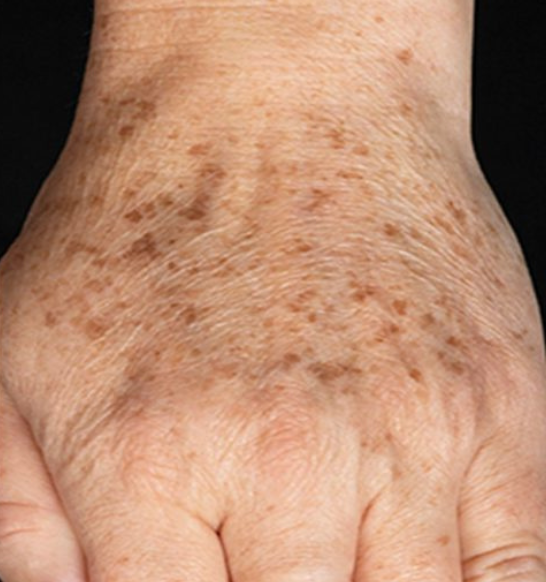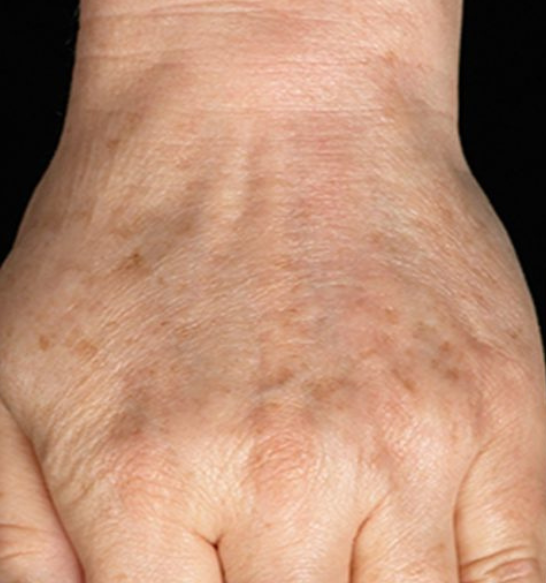

Pigmented spots: Achieve a more even complexion
Over time and with repeated exposure to the sun, brown spots—also known as solar lentigines or age spots—may gradually appear on the areas most exposed to the sun: the face, décolletage, backs of the hands, and forearms.
These spots are harmless in the vast majority of cases, but they can become more numerous and more noticeable over the years.
What treatments are available?
After a dermatological examination to confirm that the lesion is benign, two treatments may be recommended, depending on the type of spot, its location, and the patient’s skin.
Intense Pulsed Light (IPL)
IPL emits light that targets the melanin responsible for pigmentation. In the days following the treatment, the treated spots generally tend to darken temporarily and then gradually fade.
IPL is particularly effective when there are multiple spots in the same area and helps achieve a more even complexion.
Liquid nitrogen
Cryotherapy using liquid nitrogen allows for the highly localized treatment of certain pigmented lesions. Intense cold is applied to the lesion for a few seconds to destroy its surface layer.
A small scab may form after treatment and then fall off on its own within a few days.
Which treatment should I choose?
The choice between IPL and liquid nitrogen depends primarily on the number of spots, their appearance, their location, and the skin phototype. In some cases, the two techniques can be used in combination.
Regular sun protection is recommended after treatment to reduce the risk of recurrence and the appearance of new spots.
Important: Any unusual, new, or changing pigmented spot should be examined by a dermatologist before considering cosmetic treatment.